
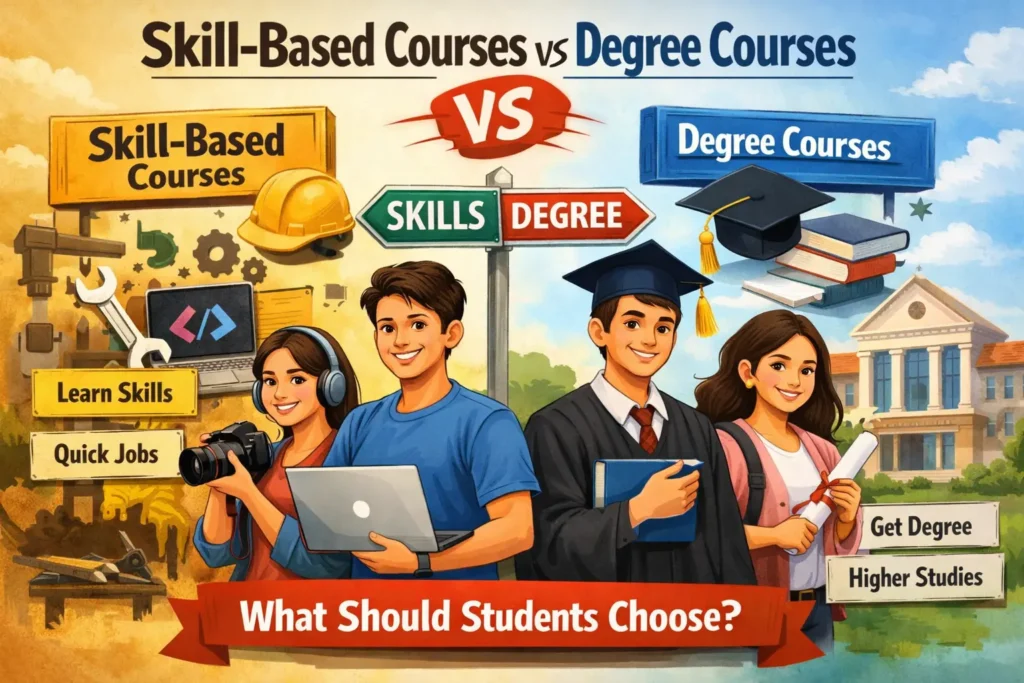
What Should Students Choose? 🎓🔧
Table of Contents
To Choose between skill-based courses and degree courses in India can feel confusing for many students after 12th. Many students and parents worry about jobs, income, and future safety. Therefore, it is very important to understand both options clearly. This article explains everything in simple words. It focuses on practical examples, real income possibilities, and future jobs in India.
What Are Degree Courses and Skill-Based Courses? 📚🛠️
A degree course is a long-term program from a university or college. It usually takes three to five years to complete. Examples include BCom, BA, BSc, BTech, BBA, MBA, MCA and MBBS. These courses focus more on theory and book knowledge.
A skill-based course teaches practical job skills in a short time. These include Web Design, Artificial Intelligence, web development, digital marketing, GST training, electrician courses, Plumber Courses and data analytics. Such courses focus more on real work than on books.
In simple words, degree courses build knowledge, while skill development courses after graduation or school build job ability.
Degree vs Skill Courses: Easy Comparison Table 📊
| Feature | Degree Courses | Skill-Based Courses |
| Duration | 3–5 years | Few months to 1 year |
| Focus | Theory + concepts | Practical training |
| Cost | Medium to High | Low to Medium |
| Job Speed | Slow | Fast |
| Flexibility | Less | More |
| Examples | BTech, BCom | Coding, GST, ITI |
Why This Choice Matters for Indian Students
In India, education is linked with family respect and social status. Many parents still prefer traditional degrees. However, today’s job market is changing fast. Companies now want skilled workers who can start working immediately.
Because of this change, job-oriented courses in India are becoming more popular. Students who combine degrees with skills often get better opportunities.
Real Student Stories from India 👨🎓👩🎓
Ravi from Himachal Pradesh
Ravi completed BCom after 12th. However, he could not find a good job quickly. Then he learned GST and accounting software online. Today, he runs a small consultancy and earns steadily.
Neha from Delhi
Neha studied BA but loved design. She joined a short-term graphic design course. Now she works remotely for foreign clients and earns from home.
Aman from Haryana
Aman joined an ITI electrician course after school. He worked as an apprentice for one year. Today, he runs his own electrical service business.
These examples show that skills plus hard work can change lives.
Earning Potential: How Much Can You Earn? 💰
Income matters a lot for students and families. Therefore, let us compare salaries.
| Course Type | Entry Salary | After 3 Years |
| BTech | ₹25k–40k | ₹60k–1L |
| Digital Marketing | ₹15k–30k | ₹50k–80k |
| Electrician | ₹12k–25k | ₹40k+ |
| Data Analyst | ₹30k–50k | ₹1L+ |
Short-term courses with high salary are possible when students keep learning and practicing regularly.
Government Support for Skill Development 📚
The Indian government supports skill learning strongly. Some important programs are:
- Skill India Digital Hub
- PMKVY (Pradhan Mantri Kaushal Vikas Yojana)
- NSDC (National Skill Development Corporation)
- NCVT Courses under ITI Institutes
These programs offer low-cost training and certifications. Many also provide placement help.
Best Career Options After 12th (Skill + Degree) 💡
Here are some popular and useful options today:
Skill-Based Options
- Web Design
- Web Development
- Digital Marketing
- Data Analytics
- GST and Accounting
- Mobile Repairing
- Electrician Training
Degree + Skill Options
- BCom + Tally/GST
- BTech + Cloud Computing
- BA + Content Writing
- BSc + Data Analysis
This combination helps students stay competitive.
Common Mistakes Students Should Avoid ⚠️
Many students make small mistakes that harm their future. Avoid these:
- Choosing courses only because friends choose them
- Ignoring internship opportunities
- Joining unrecognized institutes
- Not checking placement records
- Learning without practice
- Running after shortcuts
Smart planning avoids regret later.
How Employers Think Today 🏢
Today, many companies focus on skills and performance. They want employees who can solve problems. Therefore, portfolios, projects, and internships matter more than only certificates.
However, government jobs and research careers still require degrees. So both paths remain important.
Future Jobs in India: What Is Coming Next? 🔮
In the future, AI and automation will change many jobs. Some routine work will disappear. However, new roles will also appear.
People will need to keep learning new skills every year. Lifelong learning will become normal.
High-demand future jobs in India include:
- AI and Data Science
- Cyber Security
- Renewable Energy Technician
- Healthcare Assistants
- Digital Creators
- Cloud Engineers
Students who adapt will succeed.
Simple Decision Flowchart 🗺️
How to Decide Easily:
👉 If you like books → Degree
👉 If you like practical work → Skill
👉 If you want fast income → Skill
👉 If you want government job → Degree
👉 If you want best result → Both
Emotional Reality: Family Pressure and Career ❤️
Many students feel pressure from family to choose traditional degrees. Parents worry about safety and respect. However, today skills can also bring respect and income.
Open discussion with family helps build trust. Show them examples and career plans clearly.
Practical Step-by-Step Plan for Students 🛣️
Step 1: Explore Early
Try small online or offline courses first.
Step 2: Build Portfolio
Save projects, websites, or reports.
Step 3: Do Internships
Learn real work culture.
Step 4: Improve Communication
Good English and confidence help everywhere.
Step 5: Upgrade Regularly
Learn new tools every year.
Call to Action: Your Next Step 📣
Before choosing any course, talk to a counsellor, visit institutes, and attend demo classes. Compare fees, placement, and teaching quality carefully.
Your future depends on today’s decision. Choose wisely. Work hard. Keep learning.
Final Verdict: Degree or Skill – What Is Better? 🎯
There is no single right answer for everyone.
- Choose degree courses for stable, regulated careers.
- Choose skill-based courses for fast income and flexibility.
- Choose both for best long-term success.
Students who combine learning with practice will always stay ahead.
You may also Like:
Here are some common questions students and parents ask about skill-based and degree courses in India
Both are useful, depending on your career goal.
Degree courses are better for government jobs, higher studies, and professional fields.
Skill-based courses are better for quick jobs, freelancing, and practical careers.
The best option is often to combine both.
Yes, many students get good jobs without a degree if they have strong skills.
Fields like digital marketing, web development, graphic design, and data analytics focus more on skills.
However, for government and regulated jobs, a degree is still required.
Some popular short-term courses with good income potential are:
Digital Marketing
Web Development
Data Analytics
GST & Tally
Cloud Computing
UI/UX Design
With experience, these can pay ₹40,000 to ₹1 lakh per month.
After 12th, students can choose:
Degree + Skill (Best option)
Example: BCom + GST, BA + Content Writing
Only Degree (For long-term academic careers)
Example: BTech, MBBS
Only Skill (For fast earning)
Example: ITI, Coding Bootcamp
Your interest and financial situation should guide this choice.
Yes, they are very useful in India today.
Many graduates learn extra skills like data analysis, digital tools, and accounting software.
This helps them get better jobs and promotions.
Before joining any institute, always check:
Government recognition (NCVET, NSDC, PMKVY, ITI)
Placement records
Student reviews
Demo classes
Industry tie-ups
Never join only because of advertisements.
Yes, parents should support both degree and skill education.
Today, skilled professionals can earn well and live respectfully.
Understanding the child’s interest gives better long-term success.