
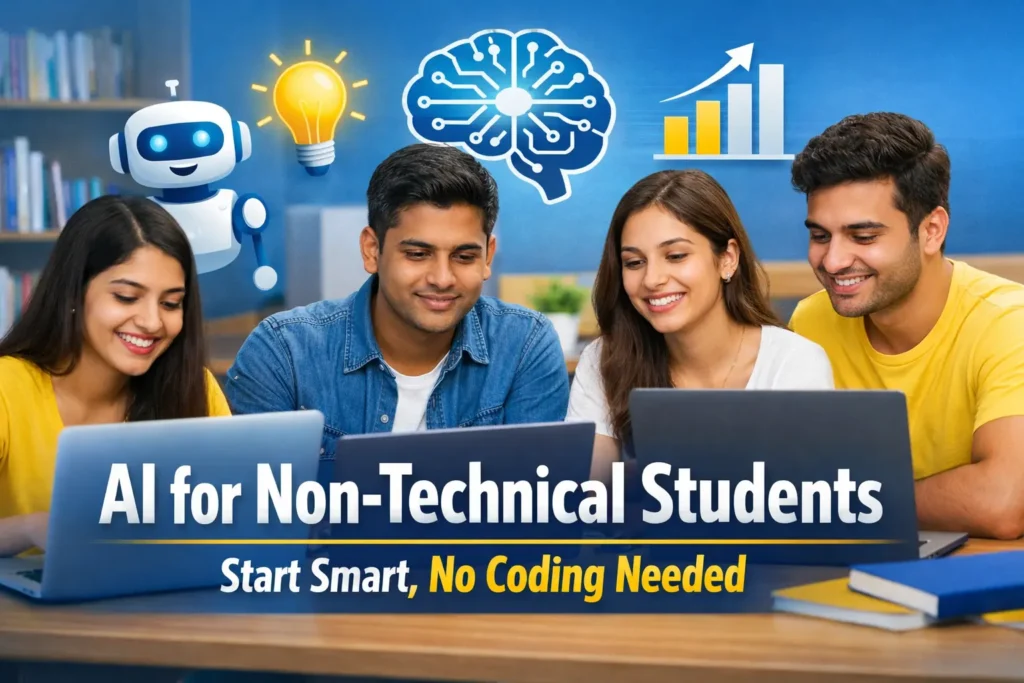
Artificial Intelligence (AI) is no longer limited to engineers, coders, or computer science graduates only. Today, students from Non- Technical fields like Arts, Commerce, Humanities, Management, Education, and even school backgrounds can easily start learning and using AI in their studies and careers 🚀.
The most comforting truth is that you do not need advanced mathematics, difficult coding, or a technical degree to begin your AI journey with confidence. With the right approach and regular practice, AI can become a powerful support tool for every non-technical student.
This complete guide explains how non-technical students can start learning AI step by step, using simple words, practical examples, emojis for clarity, and a strong Indian context that students and parents can truly relate to 🇮🇳.
📌 What Is Artificial Intelligence?
Table of Contents
(Explained Simply and step by step)
Before starting, it is important to remove fear and confusion about AI. Artificial Intelligence simply means teaching machines to perform specific tasks that normally need human thinking, such as understanding language, recognising images, or giving suggestions.
🌟 Everyday Examples of AI Around Us
- YouTube suggesting videos based on your interests 🎥
- Google Maps showing traffic-free routes 🗺️
- Amazon recommending products you may like 🛒
- Chatbots answering customer questions 💬
- Face unlock and voice assistants on smartphones 📱
If you use a smartphone or the internet daily, then you are already using AI without realising it. AI is not magic; it is simply a smart digital assistant, just like MS Word or Excel.
❌ Biggest Myth: AI Is Only for Coders and Engineers
One of the most common myths among students is that AI is only meant for technical or engineering backgrounds. In reality, most AI users are non-technical people who use ready-made tools in offices, schools, and businesses.
Modern AI tools are designed in such a way that they work with simple English instructions, making them easy for beginners.
👩🎓 How AI Helps Different Non-Technical Backgrounds
| Background | How AI Is Useful |
| Arts & Humanities | Writing, research, translation ✍️ |
| Commerce | Accounting support, reports, data analysis 📊 |
| Management | Marketing ideas, HR planning, presentations 📈 |
| Teachers | Lesson plans, worksheets, assessments 🧑🏫 |
| Students | Projects, notes, assignments 📚 |
You do not need to create AI technology; you only need to learn how to use AI smartly and responsibly.
🧠 Learn AI as a Practical Skill, Not a Tough Subject
Non-technical students should never begin AI learning with heavy theory books or technical explanations. AI should be treated as a practical life skill that saves time and improves work quality.
Just like students first learn MS Word before computer theory, or Tally before accounting rules, AI should also be learned in a tool-based and application-focused way.
💻 Basic Computer Skills Needed Before Learning AI
Before using AI tools effectively, students should be comfortable with basic computer usage. These skills make AI learning smooth and stress-free.
✅ Essential Skills
- Internet browsing and online research 🌐
- Email usage and file sharing 📧
- MS Word or Google Docs for writing 📝
- Basic Excel knowledge (rows, columns, charts) 📑
- PowerPoint or Google Slides for presentations 🎤
If you already use these tools, then you are completely ready to start learning AI.
🛠️ Best AI Tools for Non-Technical Beginners
The safest and easiest way to begin learning AI is by using ready-to-use AI tools that do not require programming knowledge.
✍️ Writing & Text AI Tools
- ChatGPT – ideas, explanations, content writing
- Grammarly – grammar and clarity improvement
- QuillBot – paraphrasing and rewriting
🎨 Design & Image AI Tools
- Canva AI – posters, resumes, social media designs
- DALL·E / Leonardo – AI image generation
🎥 Video & Audio AI Tools
These tools work with simple instructions, making them perfect for non-technical students.
🧾 Prompt Writing: The Most Important AI Skill
Prompt writing means telling AI clearly what you want and how you want it. Better prompts always give better results.
✨ Prompt Example
❌ Write about marketing
✅ Write a 300-word simple article on digital marketing for Indian students with examples
Good prompt writing improves thinking, communication, and clarity, which are natural strengths of non-technical students.
🇮🇳 Future Scope of AI in India (Realistic & Practical)
For Indian students, understanding the future scope of AI is extremely important before choosing it as a skill. The good news is that AI growth in India is practical, gradual, and job-oriented, not just foreign hype.
🎓 AI in Education
AI is already helping teachers and students through smart learning platforms, online assessments, personalised learning, and automated content creation. Non-technical students can work as AI-supported educators, content creators, and academic assistants.
🏛️ AI in Government Services
The Indian government is using AI in areas such as digital governance, public service portals, data management, smart cities, and citizen grievance systems. This creates opportunities for trained professionals who can operate and manage AI-based systems.
🏪 AI in Small Businesses
Small and medium businesses in India are adopting AI for billing, customer support, marketing, inventory management, and data analysis. Non-technical students can help local businesses use AI tools effectively.
📣 AI + Digital Marketing
AI is transforming digital marketing through content generation, ad optimisation, SEO analysis, customer behaviour tracking, and social media management. This field offers strong career opportunities for creative, non-technical learners.
📊 AI + Accounting
AI is helping accountants with automated entries, GST analysis, financial reports, and error detection. Commerce students can combine accounting knowledge with AI tools to become highly valuable professionals.
AI in India is focused on supporting jobs, improving efficiency, and upgrading skills, making it a safe and future-ready choice for non-technical students.
🎓 Use AI in Your Own Field of Study
AI learning becomes easy and interesting when you connect it with your existing subject or career goals.
- Arts students can use AI for writing and storytelling ✍️
- Commerce students can analyse data and understand GST concepts 📊
- Management students can create marketing strategies 📈
- Education students can prepare lesson plans 🧑🏫
AI should always support human skills, not replace them.
📊 Basic Data Understanding (No Maths Fear)
You do not need advanced mathematics to use AI tools effectively. Basic understanding of data, numbers, and simple charts is more than enough for beginners.
This level of knowledge is sufficient for most office, academic, and business-related AI work.
🗓️ 90-Day Simple AI Learning Roadmap
- First 30 days: AI basics and tool usage
- Next 30 days: Prompt writing and subject-based practice
- Last 30 days: Mini projects and basic certification
This roadmap keeps learning structured and stress-free.
🎯 Career Roles for Non-Technical AI Learners
Non-technical students may not become AI engineers, but they can build strong careers using AI tools effectively.
Popular roles include:
- AI content creator ✍️
- Digital marketer using AI 📣
- Office automation expert 🏢
- AI trainer or instructor 🧑🏫
- Freelance AI tool specialist 💼
These roles are already in demand across India.
⚖️ Ethical and Responsible Use of AI
AI should be used as a learning assistant, not as a shortcut for cheating. Always verify AI-generated content, respect originality, and use AI responsibly.
Responsible AI usage builds trust and long-term success.
🌟 Conclusion: AI Is an Opportunity, Not a Threat
Artificial Intelligence is a powerful opportunity for non-technical students to improve skills and career prospects. With basic computer knowledge, simple English understanding, and regular practice, anyone can start using AI confidently.
Start small, stay consistent, and allow AI to work with you, not against you.
You may also Like:
Career-Focused Best Computer Courses After 12th and Graduation
How to Learn Digital Marketing Step by Step
Short-Term vs Long-Term Computer Courses
Career Scope in Artificial Intelligence (AI) for Beginners
Yes, many AI tools work without coding and are designed for beginners.
No, AI becomes easy when learned through practical tools and daily use.
With regular practice, basics can be learned in 1–3 months.
Yes, AI-supported roles are growing rapidly across industries in India.