

Introduction
Table of Contents
What is a Variable in C?
A variable in C is a named memory location used to store data values during program execution. Each variable has a data type, name, and value.What are Variables in C? (Detailed Explanation)
A variable stores information that can change while the program runs.Example:int age = 25;Here:- int → data type
- age → variable name
- 25 → stored value
Memory Representation of Variables in C
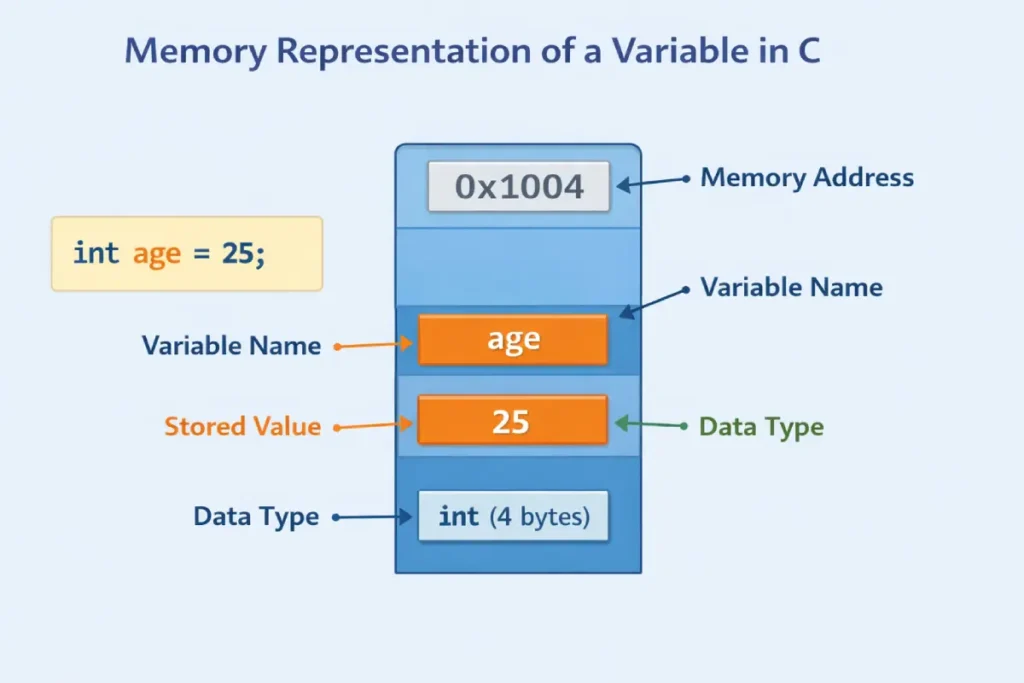
- a unique address
- a value
- a defined size based on its data type
- Variable name → label
- Memory → storage box
- Value → content inside
Special Types of Variables in C
1. Constant Variables (const)
These variables cannot be modified after initialization.
const float PI = 3.14;
2. Volatile Variables (volatile)
These variables can change unexpectedly due to external factors.
volatile int sensorValue;
- Embedded systems
- Hardware interfacing
- Interrupt handling
Syntax of Variable Declaration
data_type variable_name;Example:int marks; float price; char grade; Initialization: int marks = 90;
Rules for Naming Variables
- Must begin with a letter or underscore
- Cannot use reserved keywords
- No spaces allowed
- Case-sensitive
int studentMarks;Bad practice:
int 1marks;
Data Types of Variables in C
Integer (int)
int count = 10;
Floating Point (float, double)
float price = 99.5;

double value = 12345.6789;
Character (char)
char grade = 'A';
Fixed-Width Data Types (Modern Best Practice)
#include <stdint.h>

int32_t num = 100;
Why this matters:
- Ensures same size across all systems
- Widely used in embedded and production code
Common Data Types
| Type | Description | Example |
|---|---|---|
| int | Integer | 10 |
| float | Decimal (single precision) | 10.5 |
| double | Decimal (high precision) | 10.123456 |
| char | Single character | ‘A’ |
Where can Variables be declared in C Language
A variable in C can be declared in three place in a program-i) Inside a block of code or inside a function. These variables are called local variables in C.Features of local variables in C-- Local variables can be used by the statements that are inside the same block in which local variables are declared.
- You can declare a variable inside a code block that is nested inside any code block.
- When a local variable declared within an inner block has the same name as that declared within the outer block, the local variable in the inner block hides the local variable in the outer block.
- When we initialize the local variable to some value, this value is assigned to the variable each time it enters the block of code in which it is declared.
#include<stdio.h>
int main()
{
int guess;
printf("Think a number");
scanf("%d",&guess);
if(guess==121)
  {
       int age;
       printf("Enter your age");
       scanf("%d",&age);
       printf("So, you are quite intelligent at the age of %d",age);
  }
return 0;
}
Here guess and age are local variables. guess is local to outer block and age is local to inner block.ii) In the definition of function parameters. These variables are called formal parameters. Formal parameters is a list of variables separated by comma that will accept the different types of values being supplied to the function by the calling program.Example-#include<stdio.h>
float max(float x, float y)
{
if(x>y) return x;
else return y;
}
int main()
{
float a,b,c;
printf("Enter any two numbers");
scanf("%f%f",&a,&b);
c=max(a,b);
printf("The maximum of %f and %f is %f",a,b,c);
return 0;
}Here float x and float y are formal parameters and float a and float b are actual parameters.iii) Outside of all functions. These variables are called global variables. Global variables are available throughout the program and can be used in any part of the program.float num;
float sum;
int main()
{
/* body of main */
}in this example num and sum are global variables in c Language.Variable Scope vs Lifetime (Important Concept)
ScopeDefines where a variable can be accessed.LifetimeDefines how long a variable exists in memory.Example:int main() {
int x = 5; // local scope, limited lifetime
}Storage Classes in C (Quick Overview)
| Storage Class | Description |
|---|---|
| auto | Default local variable |
| static | Retains value between function calls |
| extern | Global variable shared across files |
| register | Stored in CPU register (fast access) |
Type Conversion in Variables
Implicit Conversionint a = 10; float b = a;Explicit Conversion
float x = (float)10 / 3;Prevents modification and improves code safety.Uninitialized Variables (Common Mistake)Wrong:
int a;

printf("%d", a);Correct:int a = 0;
printf("%d", a);To explore this concept in detail, read our complete guide on storage classes in C, where each type is explained with examples.Note– If a local variable in C is not assigned any value then it take an unpredictable value , a global and static local variable takes 0 value if not initialized or assigned any value. int vs int32_t (Important Comparison)| Feature | int | int32_t |
|---|---|---|
| Size | Platform dependent | Always 32-bit |
| Usage | General purpose | Industry / embedded |
#include <stdio.h>
int main() {
int age = 25;
float salary = 50000.5;
char grade = 'A';
printf("Age: %d\n", age);
printf("Salary: %.2f\n", salary);
printf("Grade: %c\n", grade);
return 0;
}To perform operations on variables effectively, you should understand operators in C, such as arithmetic and logical operators.Practical Tip from Industry
In real-world projects, developers prefer fixed-width types like int32_t because data size must remain consistent across systems. This is especially important in embedded systems, finance software, and cross-platform applications.Real-World Uses of Variables
Variables are used in:- Banking applications
- Student management systems
- Embedded systems (IoT devices)
- Game development
Common Mistakes Students Make
- Using outdated void main()
- Not initializing variables
- Poor naming
- Ignoring scope
Key Updates (Modern C Practices)
1. Declaration Anywhere
Older C required variables at the beginning of a block.
Modern C allows declaration anywhere:
int main()
{
int a = 10;
printf("%d", a);
int b = 20; // valid in modern C
}2. Strong Typing Matters
C is strictly typed. Mismatched assignments can cause warnings/errors:
int x = 10.5; // truncation happens
Use correct types:
float x = 10.5;
3. Use of const
To make variables read-only:
const float PI = 3.14159;
This improves code safety and clarity.
4. Fixed-Width Integers
Instead of plain int, modern C uses <stdint.h>:
#include <stdint.h> int32_t num = 100;
Why?
- Predictable size across systems
- Industry standard in embedded and systems programming
5. Variable Scope
- Local variables → inside function/block
- Global variables → outside all functions
int globalVar = 10;
int main() {
int localVar = 5;
}6. Naming Conventions (Professional Coding)
Use meaningful names:
❌ Bad:
int x;
✅ Good:
int studentAge;
7. Avoid Uninitialized Variables
int a;
printf("%d", a); // garbage valueAlways initialize:
int a = 0;
printf("%d", a);Interview Questions
Q1. What is the difference between declaration and initialization?
Declaration → creating variable
Initialization → Declaration + assigning value
Q2. What is scope of a variable?
Defines where a variable can be accessed
Q3. Why use int32_t instead of int?
Because int size varies, int32_t is fixed
Learn C Programming Practically
If you want to move beyond theory and actually build programs, it’s important to practice with real examples and projects. A structured course with hands-on training can significantly speed up your learning.👉 Book Your Free Demo Class Today 👉 Limited Seats Available 📞 Call on 9882027366 Now
Conclusion
Variables in C are not just a basic concept—they are the foundation of programming logic. Mastering variables, scope, and data types will make it easier to learn advanced topics like pointers, arrays, and structures.Author Bio
Sanjiv Kumar is a trainer, blogger, and entrepreneur with a strong focus on practical computer education. He specializes in teaching programming, digital marketing, and job-oriented skills in a simple and easy-to-understand manner. With 22+ years of experience in training students and job seekers, he is committed to helping learners build real-world skills and achieve career growth.FAQs
What is the difference between variable and constant?Variables can change; constants cannot.
Yes, in modern C
It contains garbage value.
Scope defines where the variable is accessible.
Nice topic
Pingback: Storage Classes in C - DigitalSanjiv
Pingback: File Handling in C Language With Examples