
On Page SEO for Beginners in India
Table of Contents
Every day millions of Indians search on Google to find answers, products, courses, and services. Someone may search for digital marketing course near me, while another person may search how to start a blog in India. Google shows the most relevant pages for these searches.
But have you ever wondered how Google decides which website should appear first?
The answer lies in Search Engine Optimization (SEO).
One of the most important parts of SEO is On Page SEO for beginners in India. It refers to optimizing the website content and structure of a webpage so search engines can easily understand it and show it to the right users.
Unlike backlinks or paid promotions, On Page SEO is completely under your control. By applying the right techniques, even a beginner can improve website visibility on Google.
In my experience while guiding beginners who start blogs in India, the biggest mistake is ignoring title tags and headings. Many new bloggers write good content but forget basic optimization.
This guide explains On Page SEO in very simple language, using examples from the Indian digital ecosystem so that even a beginner can understand and apply these strategies.
What is On Page SEO?
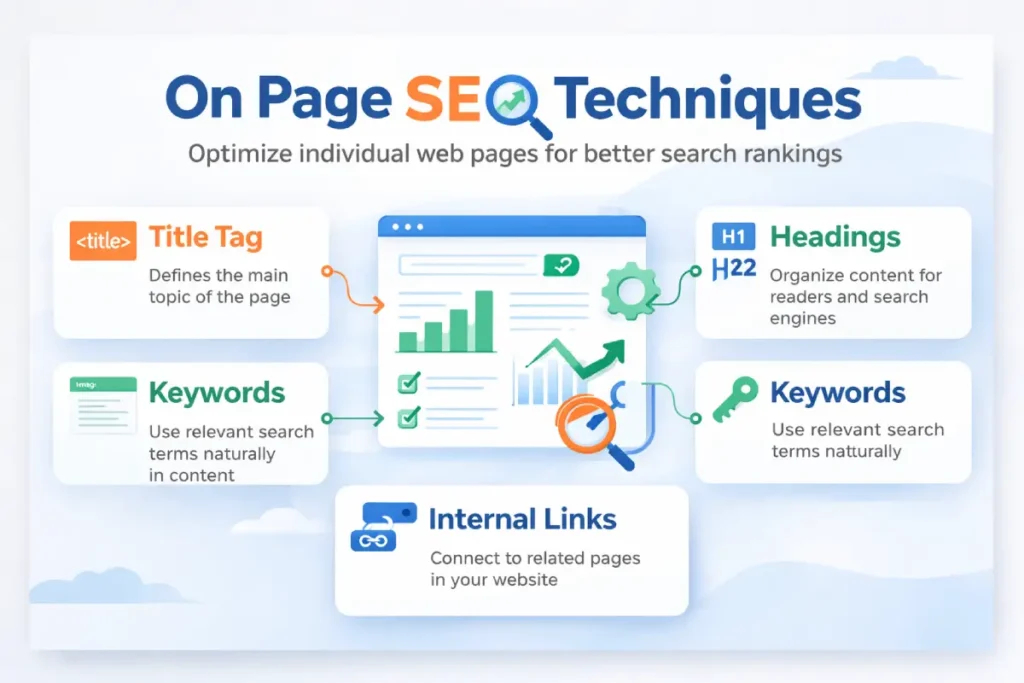
On Page SEO is the process of improving individual webpages so they rank higher in search engines.
It involves optimizing different elements of a webpage including:
- Titles
- Headings
- Keywords
- Content
- Images
- Internal links
In simple words, On Page SEO helps Google understand:
- What your page is about
- Who should see it
- When it should appear in search results
Simple Example
Imagine you write a blog about learning SEO in India.
If the article has:
- a clear title
- structured headings
- helpful explanations
- relevant keywords
then Google can easily understand the topic and show it to users searching for similar information.
Why On Page SEO is Important in India
India has one of the largest internet populations in the world. Millions of people search for information every day.
Common searches include:
- digital marketing course near me
- blogging tips for beginners
- online business ideas in India
- how to learn SEO step by step
If your webpage is properly optimized using On Page SEO techniques, it can appear in these search results.
Benefits of On Page SEO
| Benefit | Explanation |
| Higher search ranking | Optimized pages rank better on Google |
| More website visitors | Higher ranking means more traffic |
| Better user experience | Structured pages are easier to read |
| Long-term growth | SEO continues to bring traffic over time |
| Higher trust | Quality pages build credibility |
For beginners, mastering On Page SEO basics is often enough to start ranking for low competition keywords.
Step-by-Step On Page SEO Process for Beginners
Many beginners feel confused because SEO looks technical. However, the process becomes simple when broken into clear steps.
Step 1 – Find the Right Keyword
Every SEO article should focus on one main keyword.
Example keyword:
On Page SEO for beginners in India
Other related keywords may include:
- SEO basics for beginners
- learn SEO step by step
- SEO tutorial India
- search engine optimization guide
These related phrases are called LSI keywords.
Step 2 – Create an SEO Friendly URL
Your page URL should clearly describe the topic.
Bad example:
digitalsanjiv.com/post123
Good example:
digitalsanjiv.com/on-page-seo-for-beginners-india
Short and descriptive URLs help both users and search engines.
Step 3 – Write an Optimized Title Tag
The title tag is one of the strongest ranking signals.
Example title:
On Page SEO for Beginners in India: Simple Step-by-Step Guide
Best practices:
- Keep title length around 50-60 characters
- Place the keyword near the beginning
- Make it attractive for users to click
Step 4 – Write a Clear Meta Description
The meta description appears below the title in search results.
Example:
Learn On Page SEO for beginners in India with this simple guide. Understand keyword placement, website content optimization, internal linking, and ranking strategies.
Although meta descriptions do not directly affect rankings, they increase click-through rate (CTR).
Step 5 – Structure Your Headings Properly
Headings help organize your article.
Search engines use headings to understand content hierarchy.
Heading Structure
| Heading Level | Purpose |
| H1 | Main topic |
| H2 | Major sections |
| H3 | Subtopics |
Example structure:
H1
On Page SEO for Beginners in India
H2
Keyword Research
H2
Content Optimization
H3
Internal Linking
H3
Image Optimization
Clear structure improves readability and SEO.
Keyword Placement Strategy
Classic SEO still requires proper keyword placement. However, keywords should appear naturally.
Important Keyword Locations
| Location | Example |
| Title tag | On Page SEO for Beginners in India |
| URL slug | /on-page-seo-for-beginners-india |
| First paragraph | Mention keyword early |
| H2 heading | On Page SEO techniques |
| Image alt text | on page seo checklist |
Avoid repeating the keyword too many times. Google now focuses more on meaning and context rather than repetition.
Content Optimization for SEO
Content is the most important part of On Page SEO.
Google prefers content that:
- answers user questions
- provides helpful information
- explains topics clearly
Content Writing Tips
- Use simple language
- Write short paragraphs
- Use bullet points and tables
- Include examples
- Avoid unnecessary technical jargon
This approach improves user engagement and readability.
Internal Linking Strategy
Internal links connect different pages of your website.
Example:
If you have articles about free SEO tools or blogging mistakes beginners make, you should link them inside this article.
Example sentence:
“Before applying advanced strategies, beginners should explore some free SEO tools available online.”
Benefits of Internal Linking
- Helps Google understand website structure
- Improves page authority
- Helps users discover related content
Many successful blogs rely heavily on strong internal linking.
Image Optimization
Images make content visually appealing. However, poorly optimized images can slow down a website.
Image Optimization Checklist
| Task | Description |
| Compress images | Reduce file size |
| Use descriptive names | on-page-seo-guide.png |
| Add ALT text | Describe the image |
| Use modern formats | WebP loads faster |
Optimized images improve both SEO and page speed.
User Experience Signals
Modern Google algorithms evaluate how users interact with your page.
Important user signals include:
- Time spent on page
- Bounce rate
- Mobile friendliness
- Content readability
Since most internet users in India browse on smartphones, your page must be mobile friendly and fast loading.
How to Practice SEO on Your Own Website
Reading about SEO is useful, but real learning happens when you apply the concepts on your own website. The best way for beginners in India to understand search engine optimization is to experiment with a small blog or personal website and observe how search engines respond to your changes.
Here is a simple way to start practicing SEO.
1. Create a Small Practice Blog
You do not need a large website to learn SEO. A simple blog with 5–10 articles is enough to start experimenting.
Choose a topic you enjoy writing about. It could be technology tips, exam preparation, travel experiences, or digital learning. The goal is not to build a big business immediately but to understand how optimization works.
Once the website is ready, you can begin testing different SEO techniques on your pages.
2. Write Articles Around Real Search Queries
Instead of writing random topics, try writing content based on questions people ask on Google.
You can find ideas from:
Google search suggestions
“People also search for” section
Google Trends
beginner questions on forums
For example, if your blog is about blogging, you may find questions like:
how to start blogging in India
how to write SEO friendly articles
how long does SEO take to work
Creating articles around such queries helps you understand search intent, which is a core concept in SEO.
3. Test Different Title Formats
One interesting way to practice SEO is by experimenting with different title styles.
For example:
Title version 1
SEO Tips for Beginners
Title version 2
10 Simple SEO Tips Every Beginner Should Know
After publishing content, observe which style attracts more clicks in search results. Over time you will understand how titles influence user behaviour.
4. Observe How Google Indexes Your Pages
After publishing an article, submit the page in Google Search Console and wait for it to be indexed. Watching this process helps beginners understand how search engines discover new content.
You may notice that some pages get indexed quickly while others take longer. This usually depends on factors like content quality, internal links, and website structure.
5. Improve Existing Articles
SEO is not only about publishing new content. Many improvements happen by updating old articles.
For example, you can practice SEO by:
improving headings in older posts
adding internal links to related articles
updating outdated information
improving readability
Sometimes a simple update can significantly improve the visibility of an article.
6. Track Which Pages Get Traffic
After a few weeks, check your website analytics to see which articles attract visitors.
This exercise teaches an important SEO lesson: not every page performs equally. Some topics attract more interest, while others may need improvement.
Understanding these patterns helps you plan better content in the future.
Why Practicing SEO Is Important
SEO is not a skill that develops overnight. Most successful bloggers and digital marketers learned SEO gradually by testing ideas on their own websites.
When beginners regularly experiment with content, keywords, and page structure, they slowly develop a deeper understanding of how search engines evaluate webpages.
Over time, this practical experience becomes far more valuable than simply reading about SEO techniques.
On Page SEO vs Technical SEO
Beginners often confuse these two concepts.
| Aspect | On Page SEO | Technical SEO |
| Content optimization | Yes | No |
| Keyword placement | Yes | No |
| Page speed | Partial | Yes |
| Website code | No | Yes |
| Internal links | Yes | No |
On Page SEO focuses mainly on content and structure, while Technical SEO deals with website infrastructure.
Understanding On Page SEO with a Practical Example
Many beginners in India believe SEO is something very technical that only programmers or digital marketing experts can understand. In reality, the basics of On Page SEO are quite simple once you see how it works in a real situation.
Let us take a practical example.
Consider a coaching institute in Mandi offering digital marketing courses.
Target keyword:
digital marketing course near me
Optimized Page Example
| Element | Example |
| Title | Digital Marketing Course in Mandi – Beginner Friendly Training |
| URL | /digital-marketing-course-mandi |
| H1 | Digital Marketing Course in Mandi |
| Content | Explain course syllabus and benefits |
| Images | Classroom photos with alt text |
| Internal links | Link to SEO training and blogging guides |
Such optimization improves chances of ranking in local search results.
Now imagine the same page after applying proper On Page SEO.
The title becomes “Digital Marketing Course in Mandi – Beginner Friendly Training”.
The main heading clearly says “Digital Marketing Course in Mandi”.
The content explains Courses Duration, Course content, Mode of delivery and customer reviews.
Suddenly the page becomes much easier for Google to understand. When someone nearby searches for “Digital Marketing Course in Mandi” or “Best Digital Marketing course in Mandi”, the chances of that page appearing in search results become much higher.
This example shows an important truth about SEO. Google does not rank pages randomly. It tries to match the search query with pages that clearly explain the topic.
During training sessions with beginners who want to start blogging, one common pattern becomes visible. Many people write good content but ignore basic page structure. They forget to add proper headings, descriptive titles, or internal links. Because of this, search engines cannot easily interpret the content.
Once these basic On Page SEO elements are fixed, the improvement in visibility can be surprisingly fast. Even a small blog with well-structured pages can start appearing in Google results within a few months.
This is why On Page SEO is often considered the foundation of search engine optimization. Before worrying about backlinks or advanced strategies, beginners should first make sure that every page on their website is clearly organized and optimized for both users and search engines.
A Simple Story Many Beginners in India Can Relate To
A few years ago, one of my students wanted to start a blog about government job preparation. He had good knowledge and wrote detailed articles about exam preparation strategies. However, even after publishing many posts, his website was getting almost no traffic from Google.
When we looked at the website carefully, the problem became obvious. The articles were informative, but they were not optimized properly. Most titles were very generic, headings were missing, and the URLs were randomly generated by the blogging platform.
For example, one article about SSC exam preparation had the title “Study Plan”, which was too vague. After making some small On Page SEO improvements, we changed the title to “SSC Exam Study Plan for Beginners in India”, added proper headings, and rewrote the introduction so Google could clearly understand the topic.
Within a few months, the article slowly started appearing in search results for queries like “SSC preparation tips for beginners” and “SSC study plan India”.
This example highlights something very important. In many cases, beginners do not fail because of lack of knowledge. They fail because search engines cannot clearly understand their content. On Page SEO simply helps bridge that gap between good content and search engine visibility.
Common On Page SEO Mistakes Indian Beginners Make
During discussions with new bloggers and digital marketing learners, certain mistakes appear again and again. These mistakes are not complicated, but they can prevent a page from ranking properly.
One common mistake is ignoring the title tag. Many beginners write titles that are either too short or too unclear. For instance, a blog post titled “Marketing Tips” does not tell Google or readers what the content is really about. A better title would be “Digital Marketing Tips for Small Businesses in India.”
Another frequent issue is poor heading structure. Some articles use only one heading or randomly bold certain lines. Search engines prefer a clear hierarchy where the main topic appears as H1, major sections appear as H2, and smaller explanations appear as H3.
Beginners also tend to repeat the same keyword many times. This practice, known as keyword stuffing, used to work many years ago but now harms rankings. Modern search algorithms understand context, so natural language works much better.
Finally, many new bloggers forget about internal linking. Every website should guide readers toward related articles. Internal links not only help visitors explore the site but also help search engines understand how different pages are connected.
Practical On Page SEO Checklist (Use Before Publishing Any Article)
Before publishing a blog post or webpage, it helps to quickly review a few important SEO elements. This simple checklist can prevent many common mistakes.
| SEO Task | Why It Matters |
| Primary keyword in title | Helps Google identify page topic |
| Keyword used in first paragraph | Signals relevance early |
| SEO friendly URL | Makes page easier to understand |
| Proper headings (H1, H2, H3) | Improves content structure |
| Internal links added | Connects related pages |
| Images optimized with ALT text | Helps search engines interpret visuals |
| Meta description written | Encourages users to click the result |
Many experienced bloggers follow a similar checklist before publishing every article. Over time, this habit ensures that every page is optimized properly.
A Practical Observation About SEO Growth
One important thing beginners should understand is that SEO rarely produces instant results. In India’s competitive digital space, it may take several weeks or even a few months before search engines fully trust a new website.
However, once your pages are properly optimized and consistently updated with helpful content, traffic often starts growing steadily. Unlike paid advertisements that stop bringing visitors once the budget ends, SEO can continue generating visitors for a long time.
This is why many bloggers, educators, and small businesses in India gradually shift their focus toward search engine optimization. It may require patience in the beginning, but the long-term benefits can be significant.
People Also Search For
Users searching about SEO often explore related topics such as:
- SEO checklist for beginners
- Technical SEO basics
- Local SEO strategies
- SEO tools for beginners
- Google ranking factors
Including these related topics naturally in your article helps improve visibility in SERP features.
EEAT and Content Trust
Google uses EEAT signals to evaluate website credibility.
EEAT stands for:
- Experience
- Expertise
- Authoritativeness
- Trustworthiness
Ways to Improve EEAT
- Add author information
- Share real experiences
- Provide practical examples
- Maintain transparent policies
Educational websites or training platforms should clearly show who created the content and why they are qualified.
Future of On Page SEO in India
SEO is evolving rapidly due to artificial intelligence and changing search behaviour.
Emerging Trends
AI powered search
Search engines now use artificial intelligence to understand search intent more accurately.
Voice search growth
Many users now search using voice assistants like:
“best SEO course near me”
User experience signals
Google increasingly evaluates how helpful and engaging a page is for users.
Helpful content updates
Future algorithms will reward websites that provide genuine value rather than keyword-stuffed content.
Because of these trends, successful SEO strategies will focus more on quality and usefulness.
Simple On Page SEO Checklist
Before publishing any webpage, check these points.
| Task | Completed |
| Keyword in title | ✓ |
| Keyword in first paragraph | ✓ |
| SEO friendly URL | ✓ |
| Proper heading structure | ✓ |
| Internal links added | ✓ |
| Images optimized | ✓ |
| Meta description written | ✓ |
This checklist ensures your page follows basic SEO best practices.
Conclusion
Learning On Page SEO for beginners in India does not require advanced technical skills. With the right understanding and consistent practice, anyone can optimize webpages effectively.
The most important principles remain simple:
- Write helpful content
- Structure pages clearly
- Use keywords naturally
- Focus on user experience
India’s digital economy is expanding rapidly, and millions of businesses are moving online. Because of this shift, SEO skills are becoming extremely valuable.
By applying these On Page SEO techniques today, beginners can build websites that attract organic traffic and grow sustainably in the future. Have a look on Search Engine Optimization on Wikipedia as well.
You may also like :
- How to learn SEO for Beginners in India
- Free SEO Tools for Beginners (2026 Guide)
- How to Start Blogging in India with Zero Investment (Real Beginner Guide)
- How Bloggers Earn Money in India (Step-by-Step Guide for Beginners)
- How to Start Blogging in India | Complete Beginner’s Guide
About the Author
Sanjiv Kumar is a trainer, educator, and digital skills mentor who has worked closely with students and beginners exploring blogging, SEO, and online earning opportunities. Through years of teaching and interacting with learners from both small towns and urban backgrounds in India, he has observed the real challenges people face when starting their digital journey.
His work focuses on simplifying complex topics like search engine optimization, blogging, and digital marketing so that beginners can understand and apply them easily. Instead of relying only on theory, he emphasizes practical learning and real-world examples that help learners build confidence in the online space.
Through his platform, Digital Sanjiv, he regularly shares beginner-friendly guides, practical strategies, and honest insights aimed at helping aspiring bloggers, students, and small business owners understand how the digital world works.
Written by Sanjiv Kumar – SEO Trainer and Digital Skills Educator
Frequently Asked Questions
On Page SEO means optimizing the content and structure of a webpage so search engines can understand it and show it to users searching for similar topics.
On Page SEO is the foundation of ranking. However, backlinks, technical SEO, and user engagement also influence rankings.
SEO results usually appear within three to six months depending on competition and content quality.
The most important factors include keyword optimization, content quality, internal linking, page speed, and proper heading structure.