
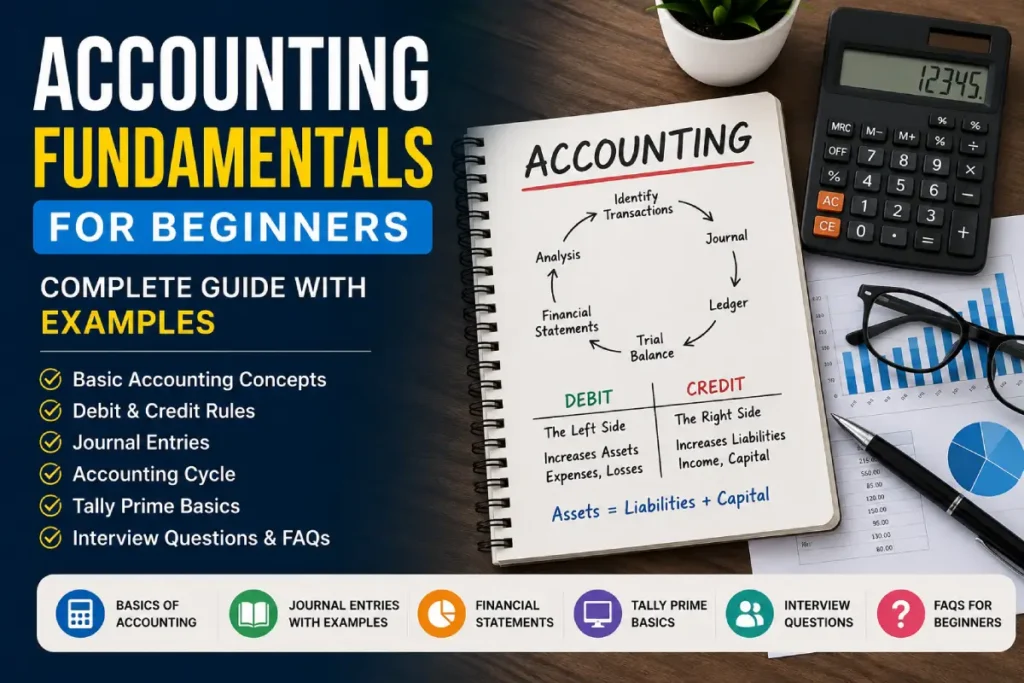
Introduction
Table of Contents
Every business transaction — whether purchasing stock, paying salary, generating GST invoices, or receiving online payments — depends on accounting. Yet many beginners struggle to understand accounting because it is often taught theoretically instead of practically.
In reality, accounting is not just for accountants or commerce students anymore. Business owners, freelancers, GST practitioners, Tally operators, startup founders, and students preparing for jobs all need strong accounting fundamentals.
Moreover, as India rapidly shifts toward digital payments, GST compliance, and computerized accounting systems, businesses increasingly demand professionals who understand accounting concepts along with software like TallyPrime. Practical Tally Prime with GST training becomes important for Accounting career growth.
This complete beginner-friendly guide will help you understand:
- What accounting is
- Basic accounting principles
- Golden rules of accounting
- Debit and credit concepts
- Journal entries with examples
- Accounting cycle
- Balance sheet basics
- Common accounting mistakes
- Practical business examples
- Tally accounting basics
- Accounting interview questions
- FAQs for beginners
If you want to build a career in accounting, GST, finance, or Tally, this guide will give you a strong foundation.
What are Accounting Fundamentals?
Accounting fundamentals are the basic principles, rules, concepts, and processes used to record and manage financial transactions in a business.
In simple words, accounting helps businesses:
- Record income and expenses
- Track profits and losses
- Maintain financial records
- Prepare tax reports
- Manage GST compliance
- Analyze business performance
Without accounting, businesses cannot understand whether they are earning profit or facing loss.
For example, if a shopkeeper sells products worth ₹1,00,000 but spends ₹80,000 on stock, rent, salary, and electricity, accounting helps calculate the actual profit.
Therefore, accounting is often called the “language of business.”
Why Accounting Fundamentals are Important
Many beginners underestimate accounting. However, accounting knowledge directly affects business decisions, tax compliance, and financial growth.
- Helps Businesses Track Financial Performance
Accounting records every transaction properly. As a result, businesses can identify:
- Total sales
- Total expenses
- Net profit
- Outstanding payments
- Essential for GST and Tax Compliance
Businesses need proper accounting records to:
- File GST returns
- Generate invoices
- Calculate tax liability
- Maintain legal compliance
Without accounting fundamentals, GST filing becomes confusing.
- Improves Business Decision-Making
Accounting reports help businesses decide:
- Which products generate maximum profit
- Where expenses should be reduced
- Whether expansion is financially possible
- Creates Career Opportunities
Today, accounting skills are highly valuable in:
- CA firms
- Retail businesses
- GST consultancy
- Startups
- Educational institutions
- Finance departments
Popular job roles include:
- Junior Accountant
- Tally Operator
- GST Executive
- Billing Executive
- Accounts Assistant
To get more insight about Salary in Tally Prime GST + career scope read this guide.
- Supports Computerized Accounting
Modern accounting software like TallyPrime works on accounting concepts. Therefore, understanding accounting fundamentals is necessary before learning software.
Difference Between Bookkeeping and Accounting
Many students think bookkeeping and accounting are the same. However, both are different.
| Basis | Bookkeeping | Accounting |
|---|---|---|
| Meaning | Recording transactions | Analyzing financial data |
| Nature | Basic process | Advanced process |
| Purpose | Maintain records | Decision-making |
| Example | Recording sales | Preparing balance sheet |
Bookkeeping is the first step of accounting.
Types of Accounts in Accounting
Accounting classifies accounts into three major categories.
Personal Account
Personal accounts relate to individuals, companies, banks, or organizations.
Examples:
- Mohan Account
- SBI Bank Account
- Reliance Account
Golden Rule:
Debit the Receiver, Credit the Giver
Real Account
Real accounts relate to assets or property.
Examples:
- Cash Account
- Machinery Account
- Furniture Account
Golden Rule:
Debit What Comes In, Credit What Goes Out
Nominal Account
Nominal accounts relate to expenses, losses, incomes, and gains.
Examples:
- Salary Account
- Rent Account
- Commission Received Account
Golden Rule:
Debit Expenses and Losses, Credit Income and Gains
What is the Double Entry System?
The double entry system is the foundation of modern accounting.
According to this system:
- Every transaction has two effects
- One account is debited
- Another account is credited
For example:
If a business purchases furniture for cash:
- Furniture increases
- Cash decreases
Therefore:
- Furniture A/c Dr.
- Cash A/c Cr.
This system helps maintain accounting accuracy.
Accounting Equation Explained
The accounting equation is one of the most important accounting principles.
Assets = Liabilities + Capital
This equation always remains balanced.
Example
Suppose a business owner invests ₹2,00,000 cash into the business.
| Assets | Amount |
|---|---|
| Cash | ₹2,00,000 |
| Liabilities + Capital | Amount |
|---|---|
| Capital | ₹2,00,000 |
Both sides remain equal.
Understanding Debit and Credit in Accounting
Many beginners fear debit and credit because they try to memorize instead of understanding logically.
In accounting:
- Debit means the left side
- Credit means the right side
However, different accounts behave differently.
Debit Increases
- Assets
- Expenses
- Losses
Credit Increases
- Income
- Liabilities
- Capital
Therefore, understanding account nature is more important than rote learning.
Journal Entries in Accounting with Examples
A journal entry is the first formal recording of a business transaction.
Every journal entry contains:
- Date
- Particulars
- Debit amount
- Credit amount
- Narration
Example 1: Furniture Purchased for Cash
Furniture worth ₹25,000 purchased in cash.
| Particulars | Debit | Credit |
|---|---|---|
| Furniture A/c Dr. | ₹25,000 | |
| To Cash A/c | ₹25,000 |
Narration: Being furniture purchased for office use.
Example 2: Salary Paid
Salary paid ₹15,000.
| Particulars | Debit | Credit |
|---|---|---|
| Salary A/c Dr. | ₹15,000 | |
| To Cash A/c | ₹15,000 |
Narration: Being salary paid to staff.
Example 3: Goods Sold for Cash
Goods sold for ₹40,000 cash.
| Particulars | Debit | Credit |
|---|---|---|
| Cash A/c Dr. | ₹40,000 | |
| To Sales A/c | ₹40,000 |
Narration: Being goods sold for cash.
Real-World Business Example of Accounting
Let us understand accounting through a practical business example.
Rahul starts a computer shop in Joginder Nagar Himachal Pradesh.
Step 1: Capital Introduced
Rahul invests ₹3,00,000.
| Particulars | Debit | Credit |
|---|---|---|
| Cash A/c Dr. | ₹3,00,000 | |
| To Capital A/c | ₹3,00,000 |
Step 2: Purchased Laptops
Purchased laptops worth ₹1,20,000.
| Particulars | Debit | Credit |
|---|---|---|
| Purchase A/c Dr. | ₹1,20,000 | |
| To Cash A/c | ₹1,20,000 |
Step 3: Sold Laptops
Sold laptops for ₹1,80,000.
| Particulars | Debit | Credit |
|---|---|---|
| Cash A/c Dr. | ₹1,80,000 | |
| To Sales A/c | ₹1,80,000 |
Step 4: Paid Shop Rent
Rent paid ₹12,000.
| Particulars | Debit | Credit |
|---|---|---|
| Rent A/c Dr. | ₹12,000 | |
| To Cash A/c | ₹12,000 |
Now Rahul can calculate:
- Sales revenue
- Business expenses
- Net profit
- Cash balance
This is how accounting works practically in real businesses.
What is Ledger Posting?
After journal entries, transactions are transferred into ledger accounts.
A ledger gives account-wise summaries.
Examples:
- Cash Ledger
- Sales Ledger
- Purchase Ledger
- Salary Ledger
Ledger posting helps businesses track balances accurately.
What is Trial Balance?
A trial balance checks whether total debit equals total credit.
If both sides match, it means:
- Mathematical accuracy exists
- Major posting errors are less likely
However, some accounting mistakes may still remain.
What are Final Accounts?
Final accounts show the financial condition of a business.
They include:
- Trading Account
- Profit and Loss Account
- Balance Sheet
Trading Account
Shows gross profit or gross loss.
Profit and Loss Account
Shows net profit or net loss.
Balance Sheet
Shows:
- Assets
- Liabilities
- Capital
It represents financial position.
Accounting Cycle Step-by-Step
The accounting cycle is a systematic process followed in accounting.
Step 1: Identify Transactions
Business transactions are identified.
Step 2: Record Journal Entries
Transactions are recorded in journals.
Step 3: Ledger Posting
Entries are transferred to ledgers.
Step 4: Prepare Trial Balance
Debit and credit totals are checked.
Step 5: Prepare Final Accounts
Financial statements are prepared.
Step 6: Analyze Financial Performance
Businesses evaluate profit, expenses, and growth.
Manual Accounting vs Computerized Accounting
Earlier, businesses maintained accounts manually in registers. However, today most businesses use accounting software.
| Manual Accounting | Computerized Accounting |
|---|---|
| Slow process | Fast process |
| More errors | Better accuracy |
| Difficult reporting | Instant reports |
| Paper records | Digital records |
Therefore, computerized accounting is now preferred.
Tally Prime Basics for Beginners
TallyPrime is one of the most widely used accounting software solutions in India.
It helps businesses:
- Record transactions
- Create GST invoices
- Manage inventory
- Generate reports
- File GST returns
However, students who learn Tally without accounting fundamentals usually struggle later.
Therefore, accounting basics should always be learned first.
Common Accounting Mistakes Beginners Make
Many students repeat the same mistakes while learning accounting.
- Memorizing Without Understanding
Beginners often memorize journal entries without understanding transaction logic.
As a result, confusion increases later.
- Confusing Debit and Credit
This is the most common mistake.
Instead of memorizing blindly, focus on understanding account nature.
- Wrong Account Classification
Example:
- Furniture = Asset
- Salary = Expense
Many students classify them incorrectly.
- Ignoring Narration
Narration explains transaction purpose. Missing narration creates confusion.
- Not Practicing Daily
Accounting is practical, not theoretical.
Without practice, concepts become weak.
Practice Questions for Beginners
Try solving these accounting transactions yourself.
- Salary paid ₹8,000
- Furniture purchased for ₹20,000 cash
- Goods sold ₹15,000 cash
- Electricity bill paid ₹2,500
- Owner invested ₹1,00,000
Regular practice improves accounting skills rapidly.
Accounting Fundamentals Interview Questions
What is accounting?
Accounting is the process of recording and analyzing financial transactions.
What are the golden rules of accounting?
- Debit the receiver, credit the giver
- Debit what comes in, credit what goes out
- Debit expenses and losses, credit incomes and gains
What is a journal entry?
A journal entry records financial transactions using debit and credit.
What is ledger posting?
Ledger posting transfers journal entries into individual accounts.
What is trial balance?
Trial balance checks whether debit totals equal credit totals.
What is the accounting equation?
Assets = Liabilities + Capital
Career Scope After Learning Accounting
Accounting offers stable career opportunities because every business needs financial management.
Popular career options include:
- Accountant
- GST Executive
- Billing Executive
- Tally Operator
- Payroll Assistant
- Accounts Manager
Additionally, freelancers offering bookkeeping and GST services can also earn good income.
As businesses continue adopting digital accounting systems, demand for skilled accounting professionals is increasing rapidly.
Final Thoughts
Accounting fundamentals are the foundation of finance, GST, taxation, and business management. Whether you want to become an accountant, learn Tally Prime, manage your business, or work in the finance industry, strong accounting basics are essential.
Moreover, businesses today prefer professionals who understand both accounting concepts and computerized accounting systems. Therefore, students who master accounting fundamentals gain better career opportunities and practical confidence.
Instead of treating accounting as a difficult subject, approach it logically. Focus on understanding transactions, practicing journal entries, and analyzing real-world examples.
Once your accounting foundation becomes strong, advanced topics like GST accounting, payroll management, inventory accounting, taxation, and financial reporting become much easier to learn.
FAQs on Accounting Fundamentals
No. Accounting becomes easy when concepts are learned practically with examples.
Yes. Students from any stream can learn accounting fundamentals. Visit the guide for Tally GST Course in Joginder Nagar with Placement n Job Training.
TallyPrime is one of the best accounting software solutions for beginners.
With regular practice, basic accounting can be learned within 1–3 months.
Yes. Accounting remains one of the most stable and in-demand career fields.
Without accounting concepts, software usage becomes mechanical and confusing.
You may also like:
Is Tally Enough for an Accounting Job in 2026? Salary, Skills & Career Reality
How to File GST Return in Tally Prime (Step-by-Step Guide
Tally Prime + GST Salary in India (2026) – ₹10,000 to ₹80,000+ Jobs & Career Scope
Pingback: Top 25 Tally Prime Shortcut Keys Every Accountant Must Know