
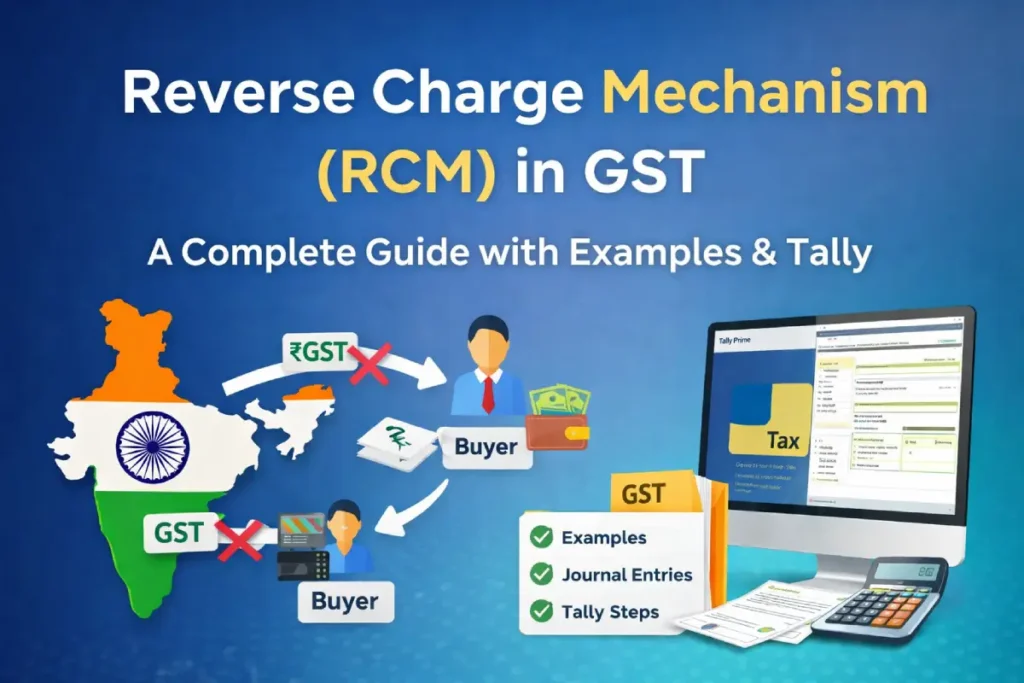
Reverse Charge Mechanism (RCM) in GST
Table of Contents
What is Reverse Charge Mechanism in GST? (Quick Answer)
Reverse Charge Mechanism (RCM) is a GST system where the buyer pays tax instead of the seller. It applies to specific goods and services or when purchasing from unregistered suppliers. Under RCM, the buyer calculates GST and pays it directly to the government.
Simple ExplanationUnder normal GST system: 👉 Seller collects GST and pays to governmentUnder RCM: 👉 Buyer pays GST directly to governmentIn One Line:
RCM shifts tax responsibility from seller to buyerWhy Government Introduced RCM
Understanding the reason helps you remember the concept forever.Main Objectives:
- To include unregistered suppliers in tax system
- To reduce tax evasion
- To ensure tax collection in service sectors
- Transport
- Legal services
- Small vendors
Legal Provision of RCM
RCM is covered under:- Section 9(3) of CGST Act → Specified goods/services
- Section 9(4) of CGST Act → Unregistered purchases
Types of Reverse Charge Mechanism
RCM is not just one type—it has two main categories.1. RCM on Specified Goods and Services
Government has notified certain services where RCM is compulsory.Important Examples
| Service | Supplier | Who Pays GST |
|---|---|---|
| Legal service | Advocate | Client |
| GTA (Transport) | Transporter | Business |
| Security service | Agency | Receiver |
2. RCM on Unregistered Dealer (URD)
If a registered person buys from an unregistered supplier, RCM may apply.👉 Example: A shop owner hires a local labourer who is not registered under GST.👉 The shop owner must pay GST.How to Activate RCM Feature in Tally:Goto Gateway of Tally -> Press F11 -> Enable Goods and Services TaxIn the GST Details screen, set Enable tax liability on reverse charge to Yes.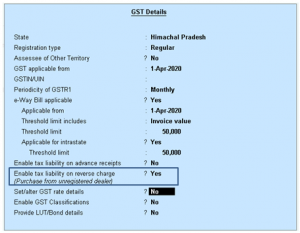
Real-Life Practical Examples
Example 1: Transport Service (GTA)
A business hires a transporter for ₹5,000.- GST Rate: 5%
- GST: ₹250
Example 2: Legal Service
A company pays ₹20,000 to a lawyer.👉 Lawyer does not charge GST 👉 Company pays GST under RCMExample 3: Local Vendor (Small Town Scenario)
In Joginder Nagar, a shop buys goods from an unregistered supplier.👉 Buyer must calculate and pay GSTRCM Calculation (Step-by-Step)
Let’s take a clear example:- Purchase Value = ₹10,000
- GST Rate = 18%
Under RCM:
- Supplier gets ₹10,000
- Buyer pays ₹1,800 to government
Accounting Entries for RCM
You can also learn detailed accounting entries in our article on Tally GST accounting entries for beginners.Step 1: Purchase Entry
Purchase A/c Dr. To Supplier A/cStep 2: GST Liability Entry
CGST A/c Dr. SGST A/c Dr. To RCM Payable A/cStep 3: Payment Entry
RCM Payable A/c Dr. To Bank A/cStep 4: ITC Claim Entry
Input CGST A/c Dr. Input SGST A/c Dr. To CGST A/c To SGST A/cHow to Record RCM in Tally Prime
To understand practical GST accounting, read our complete guide on Tally Prime GST course with real examples and job scope.Step-by-Step Process
- Enable GST in Tally
- Activate Reverse Charge option
- Create supplier ledger
- Record purchase entry
- Use correct GST rate
Practical Tip
Always check:- GST classification
- Voucher type
- Tax applicability
Input Tax Credit (ITC) Under RCM
Under RCM:👉 You MUST pay GST first 👉 Then claim ITCConditions for ITC
- GST must be paid
- Invoice must be available
- Proper accounting entry required
Important Rule
If you don’t pay GST: 👉 You cannot claim ITCRCM vs Normal GST
| Feature | Normal GST | RCM |
|---|---|---|
| Tax Paid By | Seller | Buyer |
| Invoice | Includes GST | No GST |
| ITC | Direct | After payment |
| Complexity | Low | Medium |
Compliance Under RCM (Very Important)
Businesses must:- Pay GST on time
- File returns properly
- Maintain records
Common Mistakes in RCM
| Mistake | Impact |
|---|---|
| Ignoring RCM | Penalty |
| Wrong GST rate | Loss |
| No ITC claim | Financial loss |
Who Should Learn RCM?
- Tally students
- Accountants
- Business owners
- GST practitioners
Future Scope of RCM in India
With increasing digital monitoring:- GST compliance will become stricter
- Demand for skilled accountants will rise
- Automation tools will increase
Day-to-Day Use of RCM in Real Jobs
An accountant regularly:- Checks RCM applicability
- Calculates GST
- Passes entries
- Files returns
People Also Search For
- reverse charge mechanism examples
- gst rcm entry in tally
- rcm applicability list
- gst reverse charge rules
Self Invoicing
Self-invoicing means raising a purchase invoice, which is to be done when you have purchased goods / services from an unregistered dealer AND such purchase of goods or services falls under reverse charge mechanism.Since supplier is unregistered person hence cannot issue a GST-compliant invoice to you, thus you become liable to pay taxes on the supplier’s behalf. Hence, self-invoicing, in this case, becomes necessary.All registered taxpayers are required to pay GST under reverse charge need to register for GST and the threshold of Rs 20 Lakhs does not apply to them.Exemption Limit
The government has given an exemption limit of Rs. 5,000 per day. If a total purchase is of less than Rs. 5,000 in one day from unregistered person then there is no requirement to pay tax on RCM.Time of Supply under Reverse Charge Mechanism
Time Of Supply in case of Goods
- the date of receipt of goods
- the date of payment
- immediately after 30 days from invoice date issued by the supplier
Time Of Supply in case of Services
- The date of payment
- immediately after 60 days from the invoice date of the supplier
Is Input Tax Credit allowed under Reverse Charge?
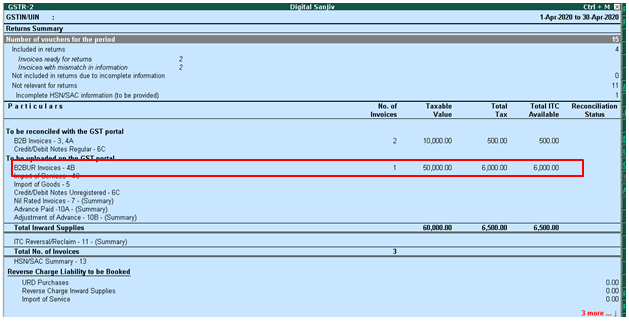
Tax paid on reverse charge mechanism will be available for input tax credit if such goods and/or services are used, or will be used, for business purpose. The recipient (i.e., who paid reverse tax) is eligible for input tax credit.How to Book Reverse Charge Liability and be eligible for Input Tax Credit.
To book Reverse Charge Liability and be eligible for ITC.From the GSTR2 report shown abovego to stat adjustments by pressing Alt+J ->select Increase of Tax Liability & Input Tax Credit in additional details select Purchase from Un-registered Dealer.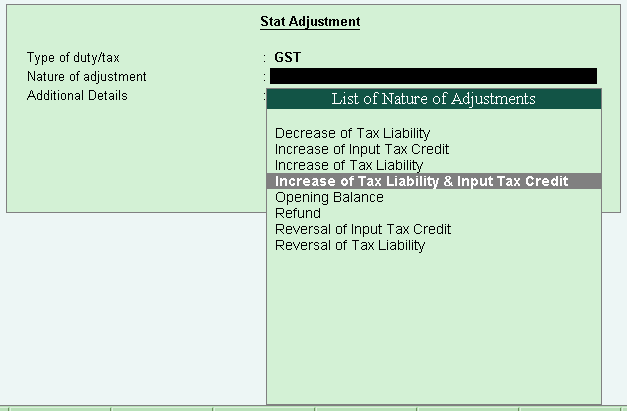
Conclusion
Reverse Charge Mechanism may seem complicated at first, but with practical understanding and examples, it becomes easy. It is an essential concept for anyone learning GST, accounting, or Tally.If you want to build a career in accounting, mastering RCM will give you a strong advantage in jobs and practical work. Reverse Charge Mechanism may seem complicated at first, but with practical understanding and examples, it becomes easy. 📞 Call Now – 9882027366 👉 Learn GST practically with real examples 💬 Book your free demo class on WhatsApp todayReverse Charge Mechanism in Tally.ERP9 has been explained both practically and theoretically. Pl feel free to comment , like and share the blog.Similar Posts : How to Activate GST in Tally.ERP9 ? Discounts in Sales Invoices in Tally.ERP9 Order Processing in Tally.ERP 9
Frequently Asked Questions
What is Reverse Charge Mechanism ?Reverse charge mechanism is a mechanism where the recipient of the goods and/or services who happens to be a registered dealer is liable to pay GST instead of the supplier
Purchase made by a GST registered dealer from un-registered dealer is exempt till Rs 5000/day. Exceeding which Recipient of goods is liable to pay Reverse Charge.
Self-invoicing means raising a purchase invoice, which is to be done when you have purchased goods / services from an unregistered dealer AND such purchase of goods or services falls under reverse charge mechanism.
On specific services and unregistered purchases.
Yes, after payment of GST.
Yes, if transaction falls under RCM category.
Very helpful
Thank you Shivani
Very Good Information
Easy and helpful notes
Thanks a lot chhaya
Nice topic
Thank you veerta
Thanks sir
Pingback: Storage Classes in C - DigitalSanjiv
Pingback: Functions - DigitalSanjiv
Pingback: Dynamic Memory Allocation in C - DigitalSanjiv